MUS 1310, History of Rock and Roll · Fall 2026
The Cory Legendre Festival of Rock History
Corwin A. (Cory) Legendre
Listen to the festival playlist on YouTube
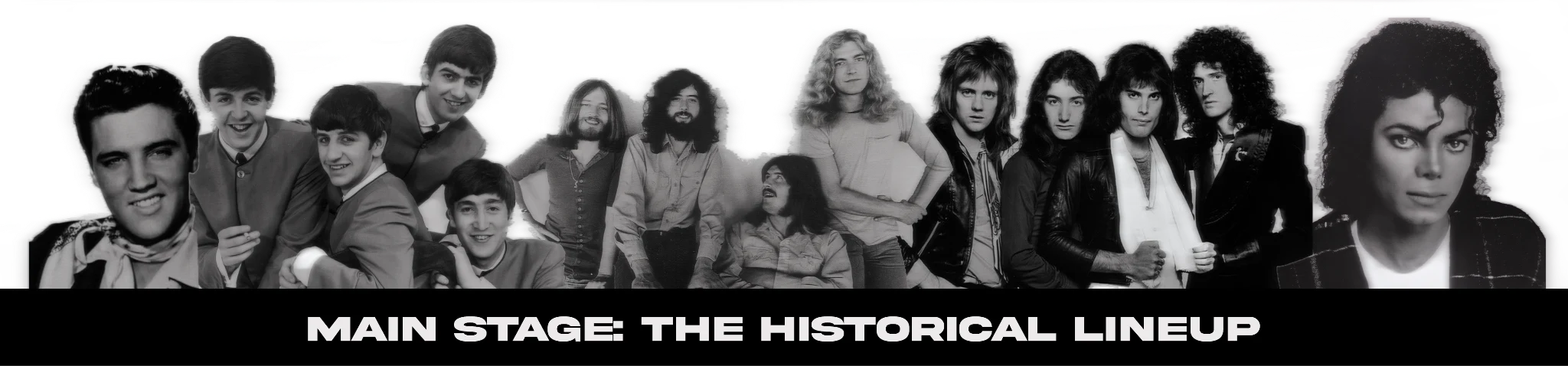
Main Stage: “The Historical Lineup”
Elvis Presley, “Heartbreak Hotel”
The Historical Lineup opens where rock and roll broke into the mainstream. Released in January 1956 as Presley’s first single for RCA Victor (Elvis Presley Official Site, n.d.), “Heartbreak Hotel” topped the Billboard pop chart for eight weeks (Trust, 2022) and became his first million-selling record (DeMain, 2025). It also climbed the country and rhythm and blues charts at the same time (Roland, 2026), which showed how rock and roll pulled together audiences that the music industry had kept apart. Built on a blues progression and drenched in echo, the song carries the loneliness of its lyrics in its sound, and a festival about the history of rock could not open anywhere else.
The Beatles, “Hey Jude”
By 1968 the Beatles had grown from a covers band playing clubs in Hamburg (T. Smith, n.d.) into the most influential group in the world, and “Hey Jude” shows how far they pushed the idea of a hit single. Paul McCartney wrote it to comfort Julian Lennon, John Lennon’s young son, while his parents divorced, turning a private kindness into an anthem of encouragement. At over seven minutes long, with a closing refrain that runs more than four minutes, it broke every rule about how long a radio song should last, yet it held the number one spot in the United States for nine weeks (The Beatles, n.d.). A whole crowd singing that ending together is the reason it belongs on the festival’s Main Stage.
Led Zeppelin, “Stairway to Heaven”
“Stairway to Heaven” captures the full range of Led Zeppelin in eight minutes. Released on the band’s untitled fourth album in 1971 (Wall, 2023), the song begins with a quiet acoustic guitar and recorders that sound almost medieval, then builds section by section until it breaks into hard rock with Page’s guitar solo and Plant’s soaring vocals (T. Smith, n.d.). That slow climb from folk to full volume works more like a movement from a classical piece than a pop song. The band refused to release it as a single in the United States, yet it became the most-played song in the history of American FM radio (Songfacts, n.d.-l; Wall, 2023). Its reach shows in the artists who returned to it decades later, from Dolly Parton’s bluegrass version in 2002 (Kaufman, 2026) to Heart’s 2012 performance at the Kennedy Center Honors, with the surviving members of Led Zeppelin watching from the audience (Lewry, 2023).
Queen, “Bohemian Rhapsody”
“Bohemian Rhapsody” is both a rock classic and, in a real sense, classical. Freddie Mercury wrote it for Queen’s 1975 album A Night at the Opera and called it a “mock opera” (Grein, 2025), and the song moves from a piano ballad into an operatic section, then into hard rock, and finally into a quiet ending, all without a repeated chorus (Breithaupt, 2023). The band layered its own voices and guitars again and again to build the sound of a full choir and orchestra, including antiphonal choruses that trade lines between a solo singer and a group (T. Smith, n.d.). Its promotional film helped shape the music video years before MTV existed (Breithaupt, 2023), and its return in the 1992 film Wayne’s World carried it to a whole new generation (Payne, 2019).
Michael Jackson, “Beat It”
The Historical Lineup closes with the song that brought the biggest star of the 1980s into rock. Jackson wrote “Beat It” for Thriller after producer Quincy Jones encouraged him to include a rock song (Songfacts, n.d.-c), and he brought in Eddie Van Halen to play the guitar solo on the original recording (Britt, 2017). That solo joined Van Halen’s hard rock technique with Jackson’s pop, and the song topped the Billboard Hot 100 for three weeks in 1983 (Trust, 2013) and won the GRAMMY for Record of the Year (Britt, 2017). Along with its music video, it helped make Thriller the best-selling album of all time (Vogel, 2015), at a moment when MTV had only just begun playing Black artists (Rubin, 2016). Closing with Jackson carries the story of rock from Presley’s echo into the video era.
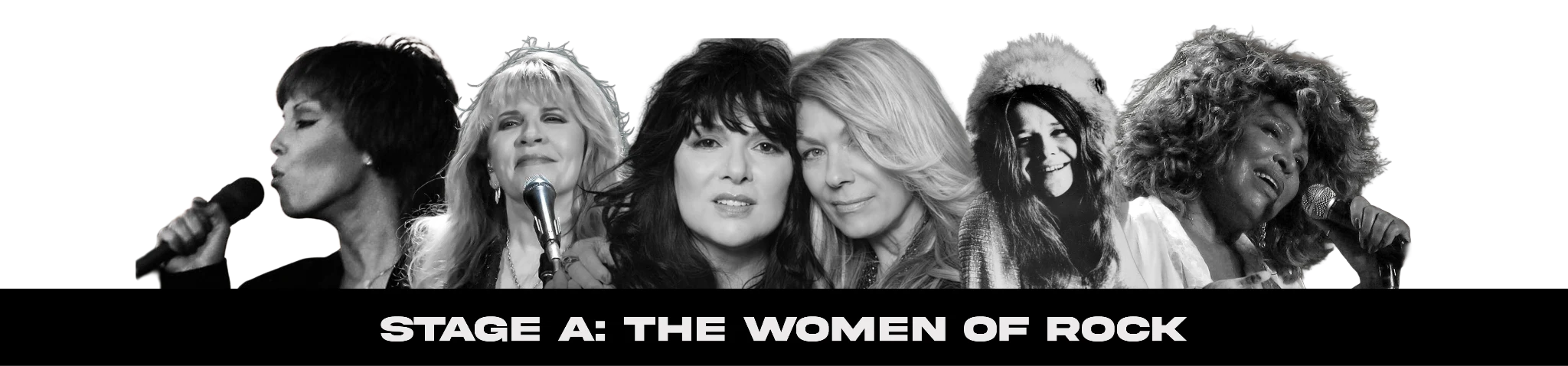
Feminist Movement: “The Women of Rock”
Janis Joplin, “Piece of My Heart”
Women of Rock opens with the voice that proved a woman could front a rock band as loudly as any man. The song first belonged to Erma Franklin, the older sister of Aretha Franklin, who recorded it as a rhythm and blues single in 1967 (Rock & Roll Hall of Fame, n.d.-c; Wang, 2009). A year later, Joplin took it with Big Brother and the Holding Company on the album Cheap Thrills and turned a plea for love into something closer to a scream. Our textbook describes Joplin’s voice as rough and utterly unique, shaped by blues, gospel, and soul (T. Smith, n.d.), and she used every bit of that power here. At a time when women in rock were expected to sound sweet, Joplin fronted an all-male band (Big Brother & the Holding Company, 2018) and refused to hold anything back, and “Piece of My Heart” became her signature song (Rock & Roll Hall of Fame, n.d.-c).
Pat Benatar, “Love Is a Battlefield”
Pat Benatar follows Joplin because she carried that same fight into the 1980s, and “Love Is a Battlefield” might be the clearest statement of it on this stage. Holly Knight and Mike Chapman wrote the song (Songfacts, n.d.-k), and it entered the charts in September of 1983. It reached number five on the Billboard Hot 100 and spent four weeks at number one on the Mainstream Rock chart (Billboard, n.d.-e, n.d.-f). In 1984 it earned her the GRAMMY for Best Female Rock Vocal Performance, her fourth win in a row in that category (Larsen, 2014). The music video helps it belong here. Benatar plays a young woman who runs away from home and ends up working at a rough club, and when a man there harasses one of the other women, she gets the dancers together and they fight back and walk out free (Larsen, 2014; Songfacts, n.d.-k). It was one of the first music videos to use spoken dialogue (Songfacts, n.d.-k), and it came out when MTV had made the video one of the main ways a song reached people (T. Smith, n.d.). Benatar used that platform to show a woman standing up for other women, and that is why she stands second in the lineup.
Stevie Nicks, “Edge of Seventeen”
Stevie Nicks comes third because she proved a woman in rock did not have to stay one voice inside a band. By 1981 she was already a star in Fleetwood Mac, but she stepped out on her own with her first solo album, Bella Donna, and it went to number one on the Billboard 200 (Billboard, n.d.-h). “Edge of Seventeen” is the song from that record that has lasted the longest. Nicks wrote it herself after the deaths of her uncle and of John Lennon in December 1980 (Songfacts, n.d.-f), so the words came from real grief. Under them is a driving guitar riff that never lets up. The title came from Tom Petty’s wife, Jane, whose Southern accent made “at the age of seventeen” sound like “edge of seventeen.” Nicks liked the sound of it and kept it (Songfacts, n.d.-f). The song reached number eleven and earned her a GRAMMY nomination for Best Female Rock Vocal Performance (Recording Academy, n.d.-b). In 2019 she became the first woman inducted into the Rock and Roll Hall of Fame twice, once with Fleetwood Mac and once on her own (Puterbaugh, 2019). That second induction is the reason she belongs on this stage: she built a career that stood on its own name.
Heart, “Alone” / “What About Love” (Medley)
Heart earns the fourth spot because Ann and Nancy Wilson fronted the first hard rock band led by women (Rock & Roll Hall of Fame, n.d.-b). They proved it early by writing their own songs. “Crazy on You” had Nancy on acoustic guitar at a time when a woman playing a guitar in rock was rare (Songfacts, n.d.-d; T. Smith, n.d.). Ann wrote “Barracuda” out of anger after their former record label, Mushroom Records, spread a made-up rumor about the two sisters to get publicity (Songfacts, n.d.-b). They moved to Capitol Records, and in 1985 “What About Love” became their comeback (Puterbaugh, 2013), their first top ten hit in five years (Songfacts, n.d.-n). Two years later “Alone” went to number one (Puterbaugh, 2013). Neither song was written by the sisters (Songfacts, n.d.-a, n.d.-n), but Ann’s voice is what made them hits. I am pairing the two as a medley because Heart still plays them together in concert, as recent fan videos show. They tell the story of a band that fought through the industry, came back, and was inducted into the Rock and Roll Hall of Fame in 2013 (Rock & Roll Hall of Fame, n.d.-b).
Tina Turner, “What’s Love Got to Do with It”
Tina Turner closes Women of Rock because nobody on this stage had to fight harder to be there. In July of 1976 she left her abusive marriage to Ike Turner in Dallas with thirty-six cents and a Mobil credit card in her pocket (Italie, 2023). In the divorce she paid her share of the cancelled concerts, and she gave up her half of the rights to their music, just to walk away free (C. E. Smith, 2021). In 1983 Capitol Records signed her anyway, even though much of the industry doubted her (Spanos, 2021), and in 1984 she released Private Dancer. “What’s Love Got to Do with It” went to number one on the Billboard Hot 100, her only number one (Billboard, n.d.-i). At forty-four, she was the oldest solo woman to top that chart up to that point (Rock & Roll Hall of Fame, n.d.-e). The song won three GRAMMYs, including Record of the Year (Italie, 2023). They called her the Queen of Rock and Roll, and she broke barriers of both race and gender to earn it (Spanos, 2021). She was inducted into the Rock and Roll Hall of Fame twice, once with Ike in 1991 and on her own in 2021 (Spanos, 2021). That second induction was hers alone, and so is the last song on this stage.
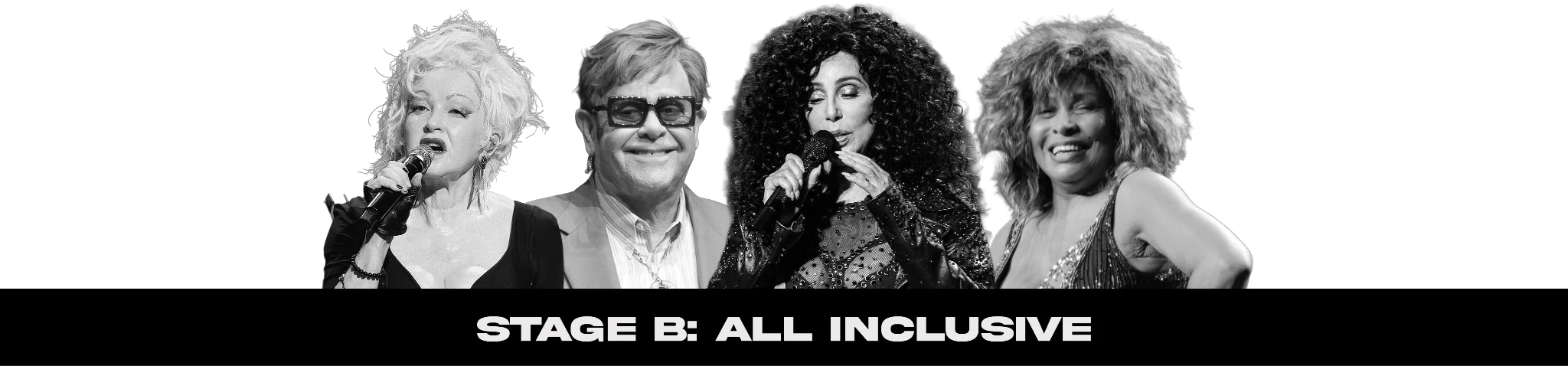
LGBTQ+ Rights: “All Inclusive”
Cyndi Lauper, “True Colors”
All Inclusive opens with Cyndi Lauper and “True Colors,” a song that grew into one of the best-known anthems of LGBTQ+ acceptance. Billy Steinberg and Tom Kelly wrote it, the same writers behind Heart’s “Alone,” which links this stage right back to Women of Rock (Songfacts, n.d.-a, n.d.-m). Lauper took their demo and stripped it down to something quiet and bare (Songfacts, n.d.-m), and in October of 1986 it went to number one on the Billboard Hot 100 (Corpuz, 2017). The words tell someone who feels unseen that they are beautiful exactly as they are, and the LGBTQ+ community heard itself in that message (Cyndi Lauper, n.d.). She headlined a 2007 tour named after the song and organized with the Human Rights Campaign, PFLAG, and the Matthew Shepard Foundation (Pollstar Staff, 2007). In 2008, she co-founded the True Colors Fund, now called True Colors United, to help homeless LGBTQ+ youth, who make up as much as forty percent of homeless youth in the United States (True Colors United, n.d.). She was inducted into the Rock and Roll Hall of Fame in 2025 (Rock & Roll Hall of Fame, n.d.-a), and “True Colors” is the song that tells people why this stage exists.
Elton John, “I’m Still Standing”
Elton John is second on All Inclusive because few people in rock history have done more for LGBTQ+ representation. He wrote “I’m Still Standing” with Bernie Taupin for the 1983 album Too Low for Zero, and heavy MTV play made it a hit on both sides of the Atlantic (Billboard, n.d.-c; Official Charts Company, n.d.; Songfacts, n.d.-h). Taupin has said the lyrics began as a goodbye to an old girlfriend, but fans turned it into a song about surviving, and Elton John lived that meaning (Songfacts, n.d.-h). Within two years, he lost two friends to AIDS: Ryan White, a teenager he befriended, and Freddie Mercury of Queen (Associated Press, 2010; Radio X, 2026). He got sober in 1990, and in 1992 he founded the Elton John AIDS Foundation, which has raised more than 660 million dollars to fight HIV around the world (Elton John AIDS Foundation, n.d.). That same year he took the stage with Queen at the Freddie Mercury Tribute Concert (Radio X, 2026), which ties this stage back to the Main Stage. In 2014 he married David Furnish after same-sex marriage became legal in England (Associated Press, 2014). He came through addiction and the AIDS crisis, and helped others through them, so when Elton sings that he is still standing, the crowd knows it is true.
SPECIAL PERFORMANCE: Tina Turner, Elton John, and Cher, “Proud Mary”
In the middle of All Inclusive comes the one moment in the festival where artists cross over from another stage. John Fogerty wrote “Proud Mary” for Creedence Clearwater Revival in 1969, and it went to number two (Bertram, 2023). Two years later, Ike and Tina Turner made it their own, starting slow and easy before tearing into it, and their version won a GRAMMY (Bertram, 2023). On April 13, 1999, at VH1 Divas Live in New York, Tina brought the song back and shared it with Elton John and Cher (Discogs, n.d.; Whitney Houston Official Site, 2023), and the concert raised money for VH1’s Save The Music Foundation, which puts instruments in public schools (Save The Music Foundation, n.d.). Having Turner walk over from Women of Rock to join two of the LGBTQ+ community’s biggest influences shows that these two movements were never really apart. The rest of that night is part of why this stage is built the way it is, because Elton John went on to sing “I’m Still Standing,” and Cher followed with “If I Could Turn Back Time” and “Believe” (Discogs, n.d.; setlist.fm, n.d.). This special performance is my way of bringing a piece of that iconic night to the festival.
Cher, “If I Could Turn Back Time”
Cher comes to the stage with “If I Could Turn Back Time,” the song that made her a rock star again in 1989. Diane Warren wrote it, and Cher did not like it at first (Songfacts, n.d.-g). Warren says she held Cher’s leg down in the studio until she agreed to try it (Ginsberg, 2014). It went to number three on the Billboard Hot 100 (Billboard, n.d.-b). Cher filmed the music video on the battleship USS Missouri in a revealing outfit, and after complaints, MTV only aired the music video late at night (Songfacts, n.d.-g). Cher did not tone herself down for anybody, and that confidence is exactly why this crowd has loved her for decades.
Cher, “Believe”
Cher closes All Inclusive with “Believe,” the biggest song of her career and one of the best-known dance anthems in LGBTQ+ culture. It came out in 1998, and its lyrics are about finding inner strength after heartbreak. The producers pushed Auto-Tune to its extreme on her voice on purpose, and the sound was copied so often that it became known as the “Cher effect” (O’Brien, 2023). It reached number one when she was fifty-two, making her the oldest woman to top the Hot 100 at the time (Billboard, n.d.-b; Trust, 2023). Cher has spoken up for LGBTQ+ rights and HIV/AIDS awareness for years, and the community made her an icon in return (Daw, 2018; New York State Department of Health, 1987). “Believe” won Cher her first GRAMMY (O’Brien, 2023), and in 2026 the Recording Academy honored her with its Lifetime Achievement Award (Ochoa, 2025). No other song could end this stage.
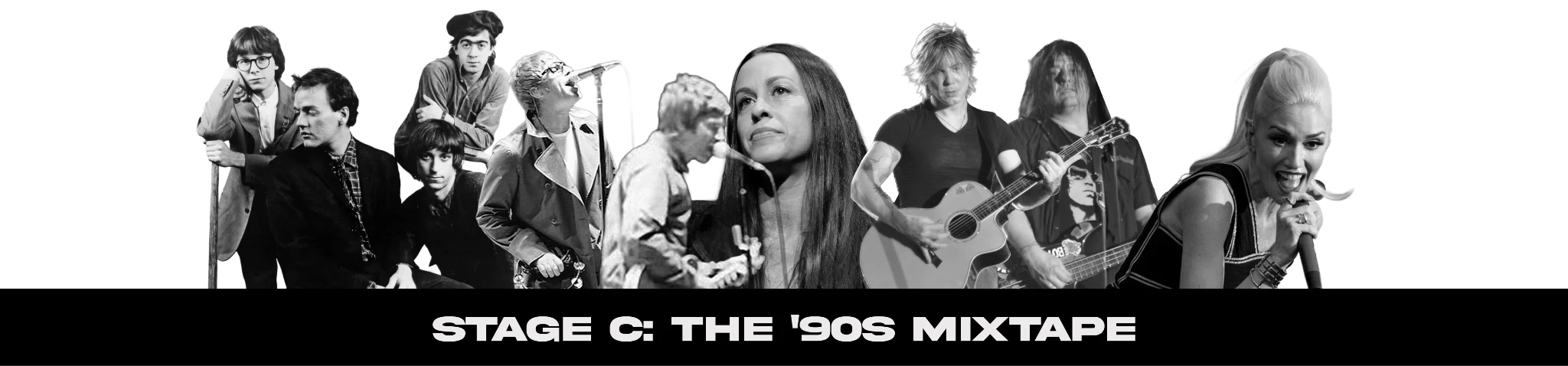
Alternative Rock: “The ’90s Mixtape”
R.E.M., “Losing My Religion”
The ’90s Mixtape opens with R.E.M., the band our textbook calls one of the earliest examples of alternative rock (T. Smith, n.d.). They spent the 1980s growing on college radio, and in February of 1991 “Losing My Religion” carried that underground sound to the mainstream (McDonald, 2012; R.E.M. HQ, 2011). Peter Buck built the song around a riff he wrote while learning the mandolin (Songfacts, n.d.-j), and the textbook uses this exact song to show how the band’s sound grew (T. Smith, n.d.). It became their biggest hit, reaching number four on the Billboard Hot 100 (Billboard, n.d.-g). It opened the decade, so it opens this stage.
Oasis, “Wonderwall”
Oasis brings the British side of alternative rock, arriving just as the Grove reading says alternative rock became mainstream in the mid-1990s (McDonald, 2012). Noel Gallagher wrote “Wonderwall” (Rock & Roll Hall of Fame, n.d.-d) and it came out in October of 1995 at the height of Britpop (Beaumont, 2019; Schatz, 2020). He took the title from George Harrison’s solo album Wonderwall Music (Songfacts, n.d.-o), a small nod back to the Beatles on our Main Stage. It became their biggest hit in the United States (Billboard, n.d.-d), and in 2020 it was the first song from the 1990s to reach one billion streams on Spotify (Schatz, 2020).
Alanis Morissette, “Ironic”
Alanis Morissette brings the raw, personal songwriting that made her one of the biggest voices in 1990s alternative rock. She wrote “Ironic” with Glen Ballard (Songfacts, n.d.-i) for Jagged Little Pill, an album that sold more than thirty million copies (Hume, 2024) and made her the youngest artist at the time to win a GRAMMY for Album of the Year (Richin, 2015). It reached number four in 1996, her highest-charting single in the United States (Billboard, n.d.-a). People still argue that most of the situations in the song are bad luck and not irony (Partridge, 2015), and a song about irony missing the mark is its own kind of ironic.
No Doubt, “Don’t Speak”
No Doubt started as a ska punk band from Anaheim (Crossley, 2025), but “Don’t Speak” showed they could slow down and still hit hard. Gwen Stefani wrote it with her brother Eric as a love song, then rewrote it into a breakup song after her seven-year relationship with bassist Tony Kanal ended, and Kanal stayed in the band to play it with her (Crossley, 2025; Songfacts, n.d.-e). It spent sixteen weeks at number one on Billboard’s airplay chart (Trust, 2018) and earned a GRAMMY nomination for Song of the Year (Recording Academy, n.d.-a), but it never appeared on the main Hot 100. In 1996, that chart only counted songs sold as a physical single in the United States, and the band never released one (Trust, 2018).
Goo Goo Dolls, “Iris”
The festival closes with the Goo Goo Dolls and “Iris,” a song written for the 1998 film City of Angels (MacIntosh, 2013). John Rzeznik saw an early screening of the film (Yates, 2019), and wrote “Iris” about the main character giving up living forever just to feel something human (MacIntosh, 2013). Like “Don’t Speak,” it had no physical single, so it could not enter the Hot 100, but it broke that song’s record with eighteen weeks at number one on the airplay chart (Aniftos, 2024; Trust, 2018). Billboard changed the rule on December 5, 1998, during its last week on top, and “Iris” finally entered the Hot 100 and reached number nine (Trust, 2018). A song that the charts could not count at first became one that everyone knows by heart, and there is no better way to end the night.
References
106 sources
- Albert B. Grossman Management. (1969). Janis Joplin publicity photograph [Photograph]. Wikimedia Commons. https://commons.wikimedia.org/wiki/File:Janis_Joplin_seated_1970.JPG
- Aniftos, R. (2024, November 20). Goo Goo Dolls' 1998 hit 'Iris' is now certified diamond. Billboard. https://www.billboard.com/music/music-news/goo-goo-dolls-iris-riaa-diamond-1235834577/
- Arvesen, R. (2017). Stevie Nicks performing at the Frank Erwin Center [Photograph]. Wikimedia Commons. https://commons.wikimedia.org/wiki/File:Stevie_Nicks_2017.jpg
- Associated Press. (2010, April 29). Elton John says Ryan White turned his life around. Deseret News. https://www.deseret.com/2010/4/29/20111818/elton-john-says-ryan-white-turned-his-life-around/
- Associated Press. (2014, December 21). Elton John, David Furnish convert civil partnership into marriage. CBC News. https://www.cbc.ca/news/entertainment/elton-john-david-furnish-convert-civil-partnership-into-marriage-1.2880616
- Atlantic Records. (1971). Led Zeppelin promotional photograph [Photograph]. Wikimedia Commons. https://commons.wikimedia.org/wiki/File:Led_Zeppelin_-_promotional_image_(1971).jpg
- Beaumont, M. (2019, August 14). Blur and Oasis' big Britpop chart battle – the definitive story of what really happened. NME. https://www.nme.com/blogs/nme-blogs/blur-and-oasis-big-britpop-chart-battle-the-definitive-story-of-what-really-happened-757277
- Bertram, C. (2023, May 24). How "Proud Mary" made Tina Turner a household name. Biography. https://www.biography.com/musicians/tina-turner-proud-mary-origins
- Big Brother & the Holding Company. (2018). History. https://www.bbhc.com/history/
- Billboard. (n.d.-a). Alanis Morissette chart history: Billboard Hot 100. Retrieved September 27, 2026, from https://www.billboard.com/artist/alanis-morissette/chart-history/hsi/
- Billboard. (n.d.-b). Cher chart history: Billboard Hot 100. Retrieved September 27, 2026, from https://www.billboard.com/artist/cher/chart-history/hsi/
- Billboard. (n.d.-c). Elton John chart history: Billboard Hot 100. Retrieved September 27, 2026, from https://www.billboard.com/artist/elton-john/chart-history/hsi/
- Billboard. (n.d.-d). Oasis chart history: Billboard Hot 100. Retrieved September 27, 2026, from https://www.billboard.com/artist/oasis/chart-history/hsi/
- Billboard. (n.d.-e). Pat Benatar chart history: Billboard Hot 100. Retrieved September 27, 2026, from https://www.billboard.com/artist/pat-benatar/chart-history/hsi/
- Billboard. (n.d.-f). Pat Benatar chart history: Mainstream Rock Airplay. Retrieved September 27, 2026, from https://www.billboard.com/artist/pat-benatar/chart-history/rtt/
- Billboard. (n.d.-g). R.E.M. chart history: Billboard Hot 100. Retrieved September 27, 2026, from https://www.billboard.com/artist/r-e-m/chart-history/hsi/
- Billboard. (n.d.-h). Stevie Nicks chart history: Billboard 200. Retrieved September 27, 2026, from https://www.billboard.com/artist/stevie-nicks/chart-history/tlp/
- Billboard. (n.d.-i). Tina Turner chart history: Billboard Hot 100. Retrieved September 27, 2026, from https://www.billboard.com/artist/tina-turner/chart-history/hsi/
- Breithaupt, D. (2023, January 3). "Bohemian Rhapsody"—Queen (1975) [Essay]. National Recording Registry, Library of Congress. https://www.loc.gov/static/programs/national-recording-preservation-board/documents/Bohemian-Rhapsody_Breithaupt.pdf
- Britt, B. (2017, May 15). Michael Jackson's GRAMMY night "Thriller": 30 years later. GRAMMY.com. https://www.grammy.com/news/30-years-later-michael-jacksons-thrilling-grammy-night/
- Corpuz, K. (2017, June 22). Cyndi Lauper's biggest Billboard Hot 100 hits. Billboard. https://www.billboard.com/pro/cyndi-lauper-biggest-billboard-hot-100-hits/
- Crossley, N. (2025, November 13). "I ended up rewriting the lyrics and changing the whole song because Tony broke up with me": How Gwen Stefani channeled the pain of rejection into the No.1 song that catapulted No Doubt to worldwide fame. MusicRadar. https://www.musicradar.com/artists/i-ended-up-rewriting-the-lyrics-and-changing-the-whole-song-because-tony-broke-up-with-me-that-song-really-is-the-heartbeat-of-who-i-am-how-gwen-stefani-channeled-the-pain-of-rejection-into-the-no-1-song-that-catapulted-no-doubt-to-worldwide-fame
- Cyndi Lauper. (n.d.). 35th anniversary of Cyndi Lauper's True Colors. https://cyndilauper.com/35th-anniversary-of-cyndi-laupers-true-colors/
- Daw, S. (2018, July 19). Cher recalls her first interaction with gay people in new interview. Billboard. https://www.billboard.com/articles/news/pride/8466236/cher-interview-gay-people
- DeMain, B. (2025, October 17). Behind the song: "Heartbreak Hotel." Performing Songwriter. https://performingsongwriter.com/heartbreak-hotel/
- Discogs. (n.d.). VH1 Divas Live/99 [Album]. Retrieved September 27, 2026, from https://www.discogs.com/release/1786606-Various-VH1-Divas-Live99
- Elton John AIDS Foundation. (n.d.). About us. Retrieved September 27, 2026, from https://www.eltonjohnaidsfoundation.org/about-us/
- Elvis Presley Official Site. (n.d.). Heartbreak Hotel. Sony Music Entertainment. https://www.elvisthemusic.com/music/heartbreak-hotel/
- Escobar, H. (2007). Pat Benatar [Photograph]. Wikimedia Commons. https://commons.wikimedia.org/wiki/File:PAT_BENATAR_2007-09-07_(cropped).jpg
- Fresch, W. (2005). Liam and Noel Gallagher of Oasis performing in San Diego [Photograph]. Wikimedia Commons. https://commons.wikimedia.org/wiki/File:Oasis_Noel_and_Liam_2005.jpg
- Ginsberg, M. (2014, July 21). Diane Warren reveals Cher's reaction to "If I Could Turn Back Time": "F--- you, bitch!" The Hollywood Reporter. https://www.hollywoodreporter.com/music/music-news/diane-warren-reveals-chers-reaction-719854/
- Grein, P. (2025, September 25). Queen's "Bohemian Rhapsody": 14 things about the song on its birthday. Billboard. https://www.billboard.com/lists/queen-bohemian-rhapsody-anniversary-things-to-know/
- Hasebe, K. (1975). Queen, A Night at the Opera publicity photograph [Photograph]. Elektra Records. Wikimedia Commons. https://commons.wikimedia.org/wiki/File:Queen_A_Night_At_The_Opera_(1975_Elektra_publicity_photo_02).jpg
- Higuchi, J. (2013). Alanis Morissette performing at the Saban Theatre [Photograph]. Wikimedia Commons. https://commons.wikimedia.org/wiki/File:Alanis_Morissette_10_20_2013_-4_(10395333704)_(cropped).jpg
- Hoffmann, D. (1963). The Beatles press photograph [Photograph]. Capitol Records. Wikimedia Commons. https://commons.wikimedia.org/wiki/File:The_Beatles_1963_Dezo_Hoffman_Capitol_Records_press_photo_2.jpg
- Hume, A. (2024, January 7). Alanis Morissette's 'Jagged Little Pill' nears 30-year anniversary: Iconic album almost never happened. Fox News. https://www.foxnews.com/entertainment/alanis-morissettes-jagged-little-pill-nears-30-year-anniversary-iconic-album-almost-never-happened
- International Musician. (2015). Ann and Nancy Wilson: Four decades of heartfelt music [Photograph]. https://internationalmusician.org/ann-and-nancy-wilson/
- Italie, H. (2023, May 24). Tina Turner, indomitable rock legend and survivor, dies at 83. PBS NewsHour. https://www.pbs.org/newshour/arts/tina-turner-indomitable-rock-legend-and-survivor-dies-at-83
- Kaufman, S. (2026, August 26). Dolly Parton's stirring rendition of Led Zeppelin's "Stairway to Heaven" is a reminder of her limitless talent. Consequence. https://consequence.net/2026/08/dolly-parton-performance-led-zeppelin-stairway-to-heaven/
- Larsen, C. (2014, December 3). Don't mess with Pat Benatar. GRAMMY.com. https://www.grammy.com/news/dont-mess-with-pat-benatar
- Lewry, F. (2023, August 28). What happened when Heart performed Stairway to Heaven for Led Zeppelin. Louder. https://www.loudersound.com/features/heart-stairway-to-heaven-kennedy-honors
- Lorig, J. (2013). The Goo Goo Dolls performing in Norfolk, Nebraska [Photograph]. Wikimedia Commons. https://commons.wikimedia.org/wiki/File:Goo_Goo_Dolls_2013_1.jpg
- MacIntosh, D. (2013, June 12). John Rzeznik of Goo Goo Dolls [Interview]. Songfacts. https://www.songfacts.com/blog/interviews/john-rzeznik-of-goo-goo-dolls
- Mazur, K. (2008). Tina Turner performs during her 50th Anniversary Tour at Madison Square Garden [Photograph]. WireImage. https://www.nme.com/news/music/watch-footage-from-tina-turners-final-concert-3447600
- McDonald, C. (2012). Alternative rock. In Grove Music Online. Oxford University Press. https://doi.org/10.1093/gmo/9781561592630.article.A2227025
- Natkin, P. (1985). R.E.M. press photograph [Photograph]. I.R.S. Records. Wikimedia Commons. https://commons.wikimedia.org/wiki/File:R.E.M._1985_press_photo.jpg
- New York State Department of Health. (1987). Don't die of embarrassment [Poster]. National Library of Medicine Digital Collections. https://collections.nlm.nih.gov/catalog/nlm:nlmuid-101454676-img
- O'Brien, J. (2023, October 19). 10 ways Cher's "Believe" changed pop music. GRAMMY.com. https://www.grammy.com/news/cher-believe-changed-pop-music-25th-anniversary/
- Ochoa, J. (2025, December 19). The Recording Academy announces 2026 Special Merit Award honorees: Carlos Santana, Chaka Khan, Cher, Fela Kuti, Paul Simon, Whitney Houston & more. GRAMMY.com. https://www.grammy.com/news/special-merit-awards-2026-grammys-honorees-recording-academy
- Official Charts Company. (n.d.). I'm still standing – Elton John. Retrieved September 27, 2026, from https://www.officialcharts.com/songs/elton-john-im-still-standing/
- Partridge, K. (2015, June 12). Alanis Morissette's 'Jagged Little Pill' turns 20: Classic track-by-track review. Billboard. https://www.billboard.com/music/music-news/alanis-morissette-jagged-little-pill-anniversary-review-6598002/
- Payne, C. (2019, May 9). How "Bohemian Rhapsody" & "Wayne's World" made Queen a streaming champion. Billboard. https://www.billboard.com/pro/bohemian-rhapsody-waynes-world-queen-streaming/
- Pollstar Staff. (2007, March 13). True Colors on tour. Pollstar. https://news.pollstar.com/2007/03/13/true-colors-on-tour/
- Puterbaugh, P. (2013). Heart [Hall of Fame induction essay]. Rock & Roll Hall of Fame. https://rockhall25.wpenginepowered.com/wp-content/uploads/2025/10/Heart_2013.pdf
- Puterbaugh, P. (2019). Stevie Nicks [Hall of Fame induction essay]. Rock & Roll Hall of Fame. https://rockhall25.wpenginepowered.com/wp-content/uploads/2025/10/Stevie_Nicks_2019.pdf
- Radio X. (2026, April 20). Who played the Freddie Mercury Tribute Concert in 1992?https://www.radiox.co.uk/artists/queen/who-played-the-freddie-mercury-tribute-concert-in-1992/
- Raph_PH. (2019). Cher in 2019 [Photograph]. Wikimedia Commons. https://commons.wikimedia.org/wiki/File:Cher_in_2019_cropped_1.jpg
- Raph_PH. (2024a). Cyndi Lauper at the Royal Albert Hall [Photograph]. Wikimedia Commons. https://commons.wikimedia.org/wiki/File:CyndiLauperRAH260624_(42_of_51)_(53819380830)_(cropped).jpg
- Raph_PH. (2024b). Elton John at the BFI London Film Festival [Photograph]. Wikimedia Commons. https://commons.wikimedia.org/wiki/File:EltonDocBFILFF101024_(4_of_17)_(cropped).jpg
- Recording Academy. (n.d.-a). 40th Annual GRAMMY Awards. GRAMMY.com. https://www.grammy.com/awards/40th-annual-grammy-awards
- Recording Academy. (n.d.-b). Stevie Nicks. GRAMMY.com. Retrieved September 27, 2026, from https://www.grammy.com/artists/stevie-nicks/5237
- R.E.M. HQ. (2011, February 22). 20 years of Losing My Religion. https://remhq.com/news/20-years-of-losing-my-religion-3/
- Richin, L. (2015, June 13). Alanis Morissette's 'Jagged Little Pill' turns 20: Revisit 10 classic moments. Billboard. https://www.billboard.com/music/rock/alanis-morissette-jagged-little-pill-19-years-6274250/
- Rock & Roll Hall of Fame. (n.d.-a). Cyndi Lauper. https://rockhall.com/inductees/cyndi-lauper/
- Rock & Roll Hall of Fame. (n.d.-b). Heart. https://rockhall.com/inductees/heart/
- Rock & Roll Hall of Fame. (n.d.-c). Janis Joplin. https://rockhall.com/inductees/janis-joplin/
- Rock & Roll Hall of Fame. (n.d.-d). Oasis. https://rockhall.com/inductees/oasis/
- Rock & Roll Hall of Fame. (n.d.-e). Tina Turner. https://rockhall.com/inductees/tina-turner/
- Roland, T. (2026, March 31). Chart rewind: In 1956, Elvis Presley was No. 1 with two songs on three charts. Billboard. https://www.billboard.com/music/chart-beat/elvis-presley-2-number-1s-chart-rewind-march-31-1956-1236211298/
- Rubin, N. (2016). MTV [Music Television]. In Grove Music Online. Oxford University Press. https://doi.org/10.1093/gmo/9781561592630.article.A2289127
- Save The Music Foundation. (n.d.). Grants for music education. https://www.savethemusic.org/grants/
- Schatz, L. (2020, October 15). Oasis classic "Wonderwall" becomes first '90s song to hit one billion streams. Consequence. https://consequence.net/2020/10/oasis-wonderwall-one-billion-streams/
- setlist.fm. (n.d.). Cher setlist at VH1 Divas 1999, April 13, 1999. https://www.setlist.fm/setlist/cher/1999/beacon-theatre-new-york-ny-usa-1bf85148.html
- Shaull, L. (2015). Gwen Stefani of No Doubt at Global Citizen Earth Day [Photograph]. Wikimedia Commons. https://commons.wikimedia.org/wiki/File:Gwen_Stefani,_No_Doubt_(crop_2).jpg
- Smith, C. E. (2021, July 27). 45 years ago: Tina Turner files for divorce from Ike Turner. Ultimate Classic Rock. https://ultimateclassicrock.com/tina-turner-ike-divorce/
- Smith, T. (n.d.). Popular music. LibreTexts. https://human.libretexts.org/Courses/Western_Washington_University/Popular_Music_(Smith)
- Songfacts. (n.d.-a). Alone by Heart. https://www.songfacts.com/facts/heart/alone
- Songfacts. (n.d.-b). Barracuda by Heart. https://www.songfacts.com/facts/heart/barracuda
- Songfacts. (n.d.-c). Beat it by Michael Jackson. https://www.songfacts.com/facts/michael-jackson/beat-it
- Songfacts. (n.d.-d). Crazy on you by Heart. https://www.songfacts.com/facts/heart/crazy-on-you
- Songfacts. (n.d.-e). Don't speak by No Doubt. https://www.songfacts.com/facts/no-doubt/dont-speak
- Songfacts. (n.d.-f). Edge of seventeen by Stevie Nicks. https://www.songfacts.com/facts/stevie-nicks/edge-of-seventeen
- Songfacts. (n.d.-g). If I could turn back time by Cher. https://www.songfacts.com/facts/cher/if-i-could-turn-back-time
- Songfacts. (n.d.-h). I'm still standing by Elton John. https://www.songfacts.com/facts/elton-john/im-still-standing
- Songfacts. (n.d.-i). Ironic by Alanis Morissette. https://www.songfacts.com/facts/alanis-morissette/ironic
- Songfacts. (n.d.-j). Losing my religion by R.E.M. https://www.songfacts.com/facts/rem/losing-my-religion
- Songfacts. (n.d.-k). Love is a battlefield by Pat Benatar. https://www.songfacts.com/facts/pat-benatar/love-is-a-battlefield
- Songfacts. (n.d.-l). Stairway to heaven by Led Zeppelin. https://www.songfacts.com/facts/led-zeppelin/stairway-to-heaven
- Songfacts. (n.d.-m). True colors by Cyndi Lauper. https://www.songfacts.com/facts/cyndi-lauper/true-colors
- Songfacts. (n.d.-n). What about love by Heart. https://www.songfacts.com/facts/heart/what-about-love
- Songfacts. (n.d.-o). Wonderwall by Oasis. https://www.songfacts.com/facts/oasis/wonderwall
- Songwriters Hall of Fame. (n.d.). Michael Jackson [Photograph]. https://www.songhall.org/profiles/michael-jackson
- Spanos, B. (2021). Tina Turner [Hall of Fame induction essay]. Rock & Roll Hall of Fame. https://rockhall25.wpenginepowered.com/wp-content/uploads/2025/10/Tina_Turner_26746_RNRHF_2021_Highres-7.pdf
- Spittle, P. (2009). Tina Turner, 50th Anniversary Tour [Photograph]. Wikimedia Commons. https://commons.wikimedia.org/wiki/File:Tina_Turner_50th_Anniversary_Tour.jpg
- The Beatles. (n.d.). Hey Jude. Apple Corps. https://www.thebeatles.com/hey-jude
- True Colors United. (n.d.). About us. https://truecolorsunited.org/about/
- Trust, G. (2013, April 30). April 30, 1983: Michael Jackson's "Beat It" hits No. 1 on Billboard Hot 100. Billboard. https://www.billboard.com/pro/april-30-1983-michael-jacksons-beat-it-hits-no-1-on-billboard/
- Trust, G. (2018, May 30). In 1998, 'Iris,' 'Torn,' & other radio smashes hit the Hot 100 at last after a key rule change. Billboard. https://www.billboard.com/pro/hot-100-rule-change-1998-airplay-singles/
- Trust, G. (2022, June 23). Elvis Presley's Hot 100 history doesn't tell the full story. Billboard. https://www.billboard.com/pro/elvis-presley-history-hot-100-before/
- Trust, G. (2023, December 4). New old-fashioned No. 1: Brenda Lee's "Rockin' Around the Christmas Tree" tops Hot 100, 65 years after its release. Billboard. https://www.billboard.com/lists/brenda-lee-rockin-around-the-christmas-tree-number-one-hot-100/
- TV Insider. (n.d.). Elvis Presley [Photograph]. https://www.tvinsider.com/people/elvis-presley/
- Vogel, J. (2015, August 17). "Thriller"—Michael Jackson (1982) [Essay]. National Recording Registry, Library of Congress. https://www.loc.gov/static/programs/national-recording-preservation-board/documents/Thriller--FINAL.pdf
- Wall, M. (2023, March 21). "Stairway to Heaven"—Led Zeppelin (1971) [Essay]. National Recording Registry, Library of Congress. https://www.loc.gov/static/programs/national-recording-preservation-board/documents/led-zeppelin.pdf
- Wang, O. (2009, June 25). Standing in the shadow of siblings. NPR. https://www.npr.org/2009/06/25/105784279/standing-in-the-shadow-of-siblings
- Whitney Houston Official Site. (2023, April 13). Whitney Houston performed at VH1 Divas Live this day in 1999. https://www.whitneyhouston.com/news/whitney-houston-performed-at-vh1-divas-live-this-day-in-1999/
- Yates, H. (2019, January 31). The story of Iris by the Goo Goo Dolls: "It was like a gift – like: 'Oh, thanks God!'" Louder. https://www.loudersound.com/features/the-story-behind-the-song-iris-by-goo-goo-dolls